
If you already collect information in Google Forms, you are halfway to a document automation system.
The missing piece is the step that takes a submission and turns it into something useful: a certificate, a report, a Word file, or a PowerPoint deck. That is what this setup does.
With a Google Form, a template, and a short Google Apps Script, you can automatically generate documents every time someone submits the form. The example here is a course certificate. But the same structure works for much more than certificates.
Once the form fields match your template, the submission can trigger document creation, save the file to Google Drive, and even email it back to the recipient.
Start With the Template, Not the Form
The setup begins with the document you want to create.
In this case, the template is a course certificate with a few clear placeholders:
- recipient name
- course name
- location
- date
- signature
- certification ID
That matters because the form and the template have to speak the same language.
If your template expects six pieces of information, your form needs to collect those six pieces of information.
Learn how to create a template for ActiveMerge.
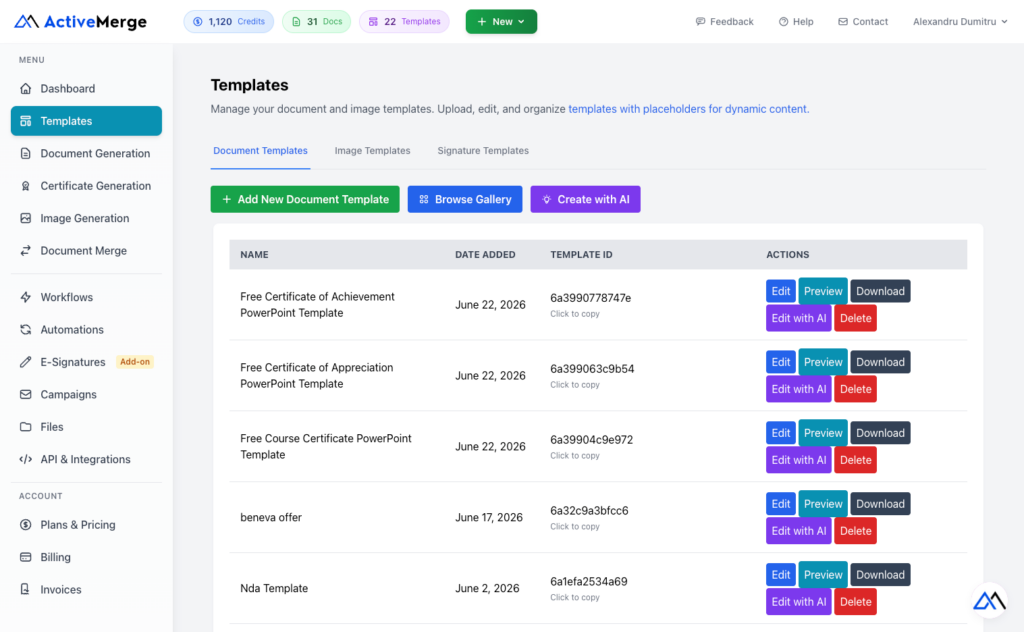
The exact order of the questions in Google Forms does not matter, but the fields themselves do.

For this demo, the form was already built with short-answer fields for:
- course name
- recipient name
- cert ID
- signature
- location
- date
Keeping everything as short-answer text keeps the setup simple. There is less to troubleshoot, and the form data is easier to map into the document.
Use Google Apps Script to Connect the Pieces
The automation runs through Google Apps Script. After creating the form, you open the script interface and paste in the provided code. The code itself is available in the video description and on the website, so you do not need to build it from scratch.
What the script does is straightforward: it connects your Google Form to Active Merge and tells the system which template to use.
See the google apps script code here.
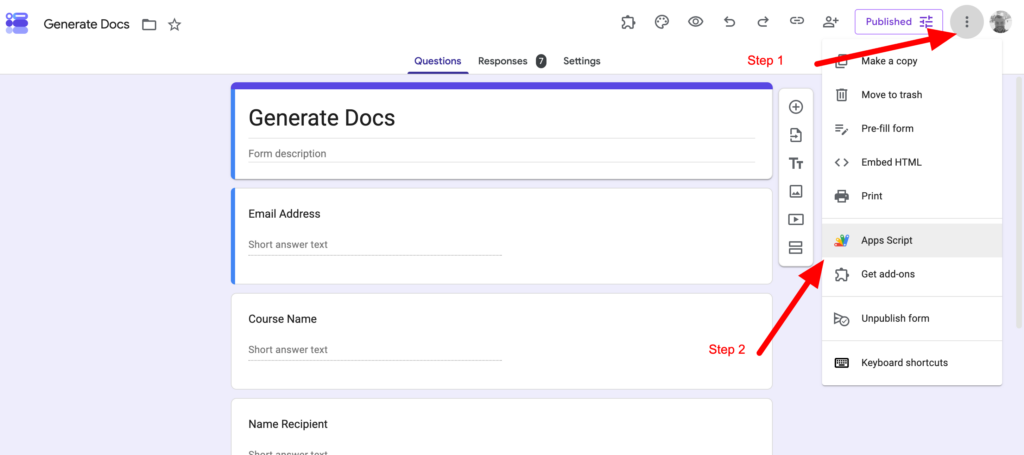
There are two key values to plug in:
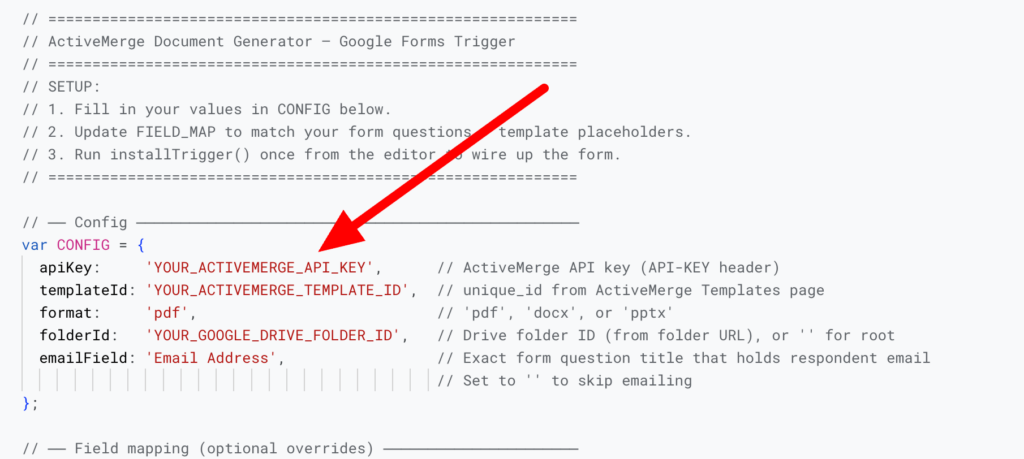
1. Your template ID
The template ID points the script to the file you want to generate from. In the demo, the certificate template ID is copied and pasted into the script.
2. Your API key
The script also needs an API key from Active Merge. You create that key in the API and integrations area of the platform. The interface supports several connection methods, including Zapier, Make, Airtable, WordPress plugins, Notion, and webhooks. For this workflow, the API key is the bridge between the form submission and the document output.
Once those values are in place, save the project and install the trigger. Then run it.
That trigger is what turns the setup from a manual tool into an automatic one. Every time someone submits the form, the script can generate the document without any extra work.
Choose Where the File Goes and What Format It Uses
After you install the trigger, you configure how to create the output.
You can choose the file format based on the template type:
- PDF for finished documents
- PPTX for PowerPoint templates
- Word for Word documents
The demo uses a template that you can handle as a PowerPoint file, but the same idea applies if you work with Word or another supported format. The important thing is to match the output format to the source template.
You also set the folder ID for Google Drive. That tells the system where to save the generated file. Instead of leaving files scattered around, each document lands in the right Drive folder automatically.
There is one more practical point here: permissions. Once you run the script, Google will ask for access so the automation can work properly. That is normal, and you have to approve it before the trigger can run on its own.
Add Email Delivery If You Want the Document Sent Automatically
Generating the file is one part of the workflow. Sending it is another.
If you want the document attached to an email, you need an email field in the form. That way, the system knows where to send the finished file. In the demo, the email address is included as one of the form fields for that reason.
This is where the workflow becomes more useful in practice. A student can fill out the form once and receive a certificate automatically. A client can submit a request and get a report back without waiting for someone to manually assemble and send it. The form becomes both the intake point and the delivery point.
A Simple Test Run Shows the Full Flow
Once the fields are in place, it is time to test.
The form is filled out with sample data:
- email address
- marketing course
- recipient name: Alex
- certificate ID
- signature person
- New York
- June 2026
After clicking submit, the document generation job starts immediately.
The file is created, and you can download the result right away. The generated certificate includes the submitted details in the right places: the name, the course, the location, the date, the signature, and the certificate ID.
Then the email arrives too. The document is attached, and the recipient can download it or view it directly from the message.
That is the real payoff: one form submission creates a finished document and delivers it without manual intervention.
Why This Approach Works
The strength of this setup is not complexity. It is the opposite.
A Google Form already gives you a clean way to collect structured data. A template already gives you a consistent document layout. The script simply ties them together.
That means you can use the same pattern for:
- certificates
- reports
- letters
- Word documents
- PowerPoint files
- any repeatable document that uses the same fields
You do not need a larger system to get started. You only need the form, the template, and the script that tells Active Merge how to assemble the output.
FAQ
What do I need to get started?
You need a Google Form, a document template, an Active Merge API key, and a Google Apps Script using the provided code.
Does the form field order have to match the template?
No. The fields can appear in any order in Google Forms, as long as the script maps the right form answers to the right template placeholders.
Can I generate more than certificates?
Yes. The same workflow can generate Word documents, PowerPoint files, reports, and other template-based documents.
Can the document be emailed automatically?
Yes, but you need an email field in the form so the system knows where to send the finished file.
Where does the generated file get saved?
You choose a Google Drive folder by entering the folder ID in the script settings.
The Bottom Line
This is a clean way to turn a Google Form into a document generation system. Once the template, form fields, API key, and trigger are in place, each submission can produce a finished file and send it where it needs to go.
If you already collect data in Google Forms, you are close to automating document creation. This setup is the missing step that makes it happen.