

In law firms, documentation is constant—contracts, case files, client agreements, discovery responses, compliance reports, and court submissions.
- What You’ll Build
-
Step-by-Step: Automate Legal Documents with ActiveMerge Workflows
- Step 1: Create an ActiveMerge Account
- Step 2: Prepare Your Case or Client Data in Google Sheets
- Step 3: Build Your Legal Templates
- Step 4: Upload Templates to ActiveMerge
- Step 5: Build a Multi-Document Workflow
- Step 6: Connect Data and Map Fields
- Step 7: Preview and Generate Documents
- Step 8: Automate Delivery & Storage
- Final Thoughts
- Real-World Use Cases
- FAQs
Manually creating and formatting these documents slows down legal teams, introduces errors, and consumes billable hours that could be better spent on client work.
ActiveMerge solves this with its Workflows feature. By pulling client or case data from Google Sheets, your practice management system, or even spreadsheets, you can automatically generate entire sets of legal documents at once—branded, accurate, and ready for review.
Instead of recreating documents from scratch, your team can prepare polished filings and agreements in seconds, while ensuring compliance and consistency.
What You’ll Build
By following this guide, your firm will set up an automation system that creates:
- A library of branded legal templates (Contracts, Client Agreements, Discovery Requests, Court Filings).
- An ActiveMerge Workflow that generates multiple documents at once for each client or case.
- Automated storage and delivery in Google Drive, Dropbox, or OneDrive, plus optional notifications for attorneys or paralegals.
This ensures every contract, agreement, or filing is generated fast, accurately, and securely.
Step-by-Step: Automate Legal Documents with ActiveMerge Workflows
Law firms handle a wide range of repetitive but essential documents—from client intake letters to contracts and discovery requests. Manually preparing these files for every case is time-consuming, error-prone, and often inconsistent.
With ActiveMerge Workflows, your firm can generate entire sets of legal documents in minutes by combining structured client data with reusable templates. Below, we’ll walk you through each step to set up, automate, and streamline your legal document generation process.
Step 1: Create an ActiveMerge Account
The first step is to establish your workspace inside ActiveMerge, where all of your legal automation will take place.
- Please visit the ActiveMerge Registration Page and register using your professional email.
- Once logged in, you’ll land on the Dashboard—this is the central hub where you’ll manage everything related to templates, workflows, and integrations.

From the dashboard, you’ll see these main sections:
- Document Generation – Quickly create individual documents from data and templates.
- Document Merge – Combine multiple files (contracts, exhibits, evidence scans) into a single PDF or Word files.
- Templates – Upload, edit, and organize your firm’s standard document templates.
- Workflows – Build automated processes that generate multiple legal documents at once.
- API Key – Connect ActiveMerge securely with your firm’s case management system or custom apps.
This setup ensures you have all the tools you need to start automating repetitive legal paperwork in one place.
Step 2: Prepare Your Case or Client Data in Google Sheets
Purpose: Centralize client and case information to merge into multiple templates automatically.
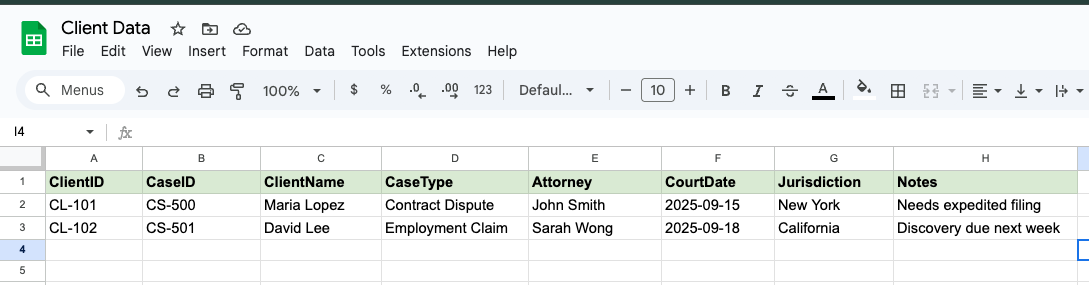
- Open Google Sheets and create a new spreadsheet for your client or case data.
- Use column headers that match the placeholders you’ll use in templates.
Example Google Sheet:
Best Practices:
- Keep headers short and clear – For example, CaseID instead of Case Identifier.
- Match headers with template tags – If your template uses {ClientName}, your sheet must have a ClientName column (exact spelling matters).
- Normalize your data – Dates should follow a consistent format (e.g., YYYY-MM-DD), jurisdictions should be consistent (New York not NY in one row and N.Y. in another).
- Avoid blanks – Use “Pending” or “N/A” instead of leaving cells empty. This prevents ActiveMerge from generating incomplete documents.
- Organize by case type – Consider using different sheets (or tabs) for litigation, contracts, compliance, etc., if your firm handles multiple practice areas.
Step 3: Build Your Legal Templates
Purpose: Create standardized, reusable templates for the most common legal documents.
Here are three examples you can start with:
Contract Template
| Contract Agreement —————— Client Name: {ClientName} Case ID: {CaseID} Attorney Assigned: {Attorney} Jurisdiction: {Jurisdiction} Notes: {Notes} Date: {CourtDate} |
Client Letter Template
| Client Letter —————— Dear {ClientName}, This letter confirms details regarding your case ({CaseType}) scheduled for {CourtDate} in {Jurisdiction}. Sincerely, {Attorney} |
Discovery Request Template
| Discovery Request —————— Case ID: {CaseID} Client: {ClientName} Attorney: {Attorney} Due Date: {CourtDate} Notes: {Notes} |
Template Rules:
- Always wrap placeholders in curly braces {ClientName})
- Align placeholders with your Google Sheet headers.
- Add your law firm’s branding – Include logos, disclaimers, confidentiality notices, and standardized formatting.
- Keep formatting compliance-friendly – Courts and regulators may have strict document standards. Use clean fonts, avoid over-styling.
- Maintain a template library – For every type of document (engagement letters, NDAs, contracts, discovery responses, motions, affidavits).
Step 4: Upload Templates to ActiveMerge
- In your ActiveMerge dashboard, go to Templates → Add Template.
- Upload your prepared Word or Google Docs templates.
- ActiveMerge will scan your template and detect placeholders.
- Example: It will recognize {ClientName} and suggest mapping it to your Google Sheet’s “ClientName” column.
- Save each template with a clear name and version (e.g., Contract_v1, Letter_v1, Discovery_v1).

Best Practice: Keep version history (Contract_v1, Contract_v2, etc.) to handle legal updates without breaking workflows that use older templates.
Step 5: Build a Multi-Document Workflow
Purpose: Bundle multiple documents into a single automated process per client or case.
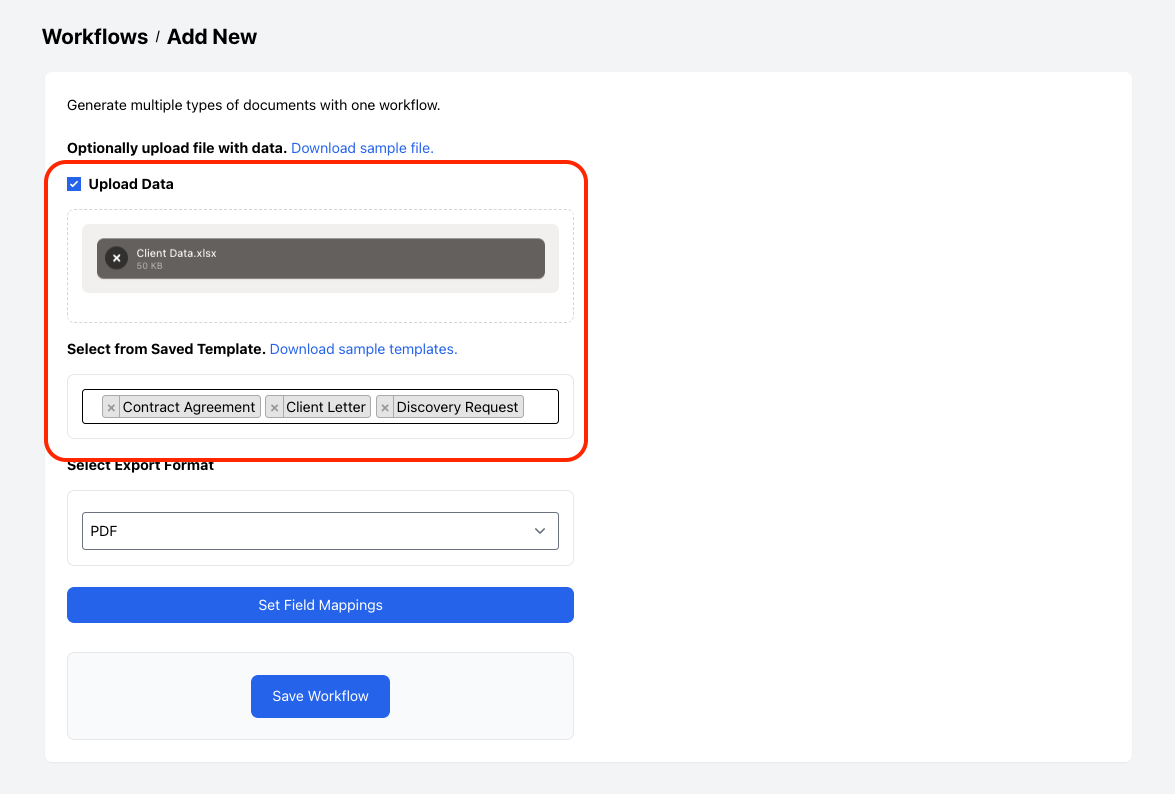
- Go to Workflows → Add New.

- Select Generate multiple types of documents with one workflow.
- Upload your client or case data (Google Sheets, CSV, or Excel export from your case system).
- Select the templates you want bundled together (e.g., Contract, Client Letter, Discovery Request).
- Choose your output format:
- PDF → Court-ready or client-ready documents that cannot be altered.
- Word (.docx) → Editable drafts that attorneys can revise before finalizing.
- Save Workflow.
Pro Tip: Create reusable workflows for frequent scenarios:
- New Client Intake Pack (Engagement Letter + Fee Agreement + Conflict Check Form).
- Pre-Hearing Document Set (Discovery Requests + Motion Template + Client Letter).
- Compliance Bundle (Regulatory Filings + Client Notification Letters).
Step 6: Connect Data and Map Fields
Purpose: Make sure your data populates correctly into each document.
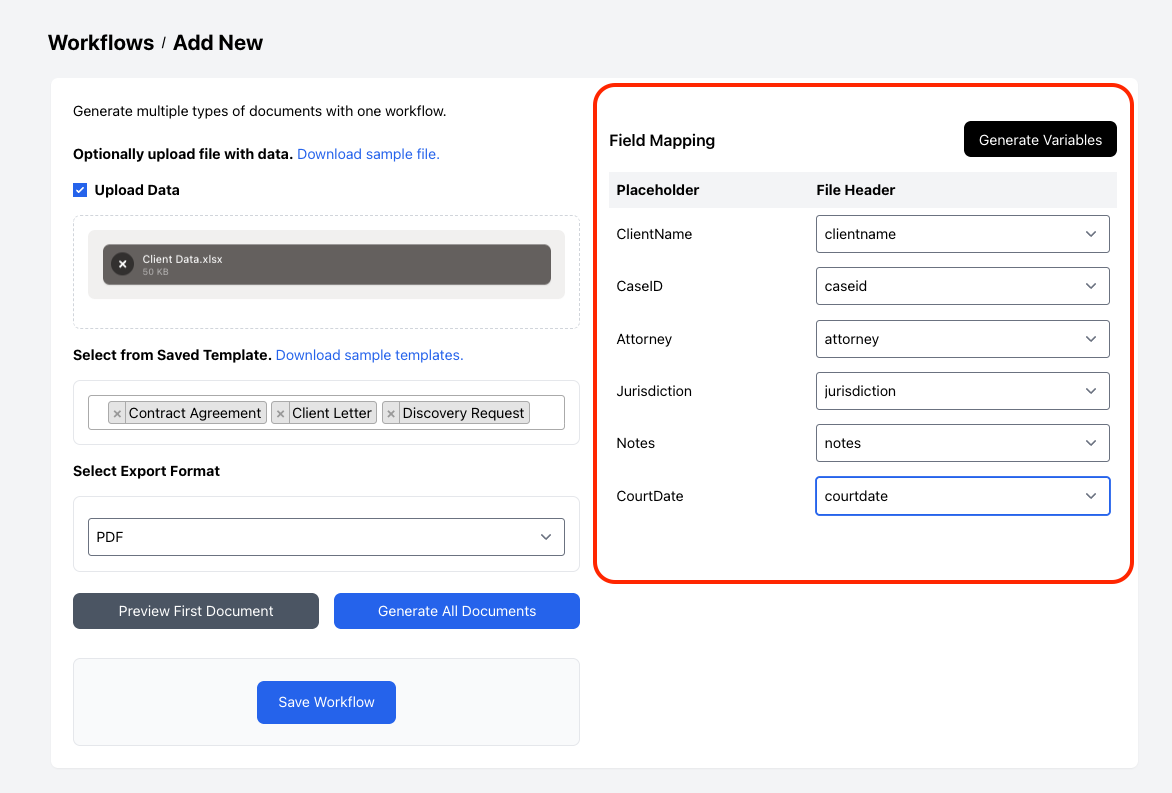
- Once you’ve selected templates and uploaded data, ActiveMerge will show a Field Mapping Screen.
- This screen lists your template placeholders and the corresponding spreadsheet headers.
Example Field Mapping:
| Placeholder | File Header |
| {ClientName} | ClientName |
| {CaseID} | CaseID |
| {Attorney} | Attorney |
| {CourtDate} | CourtDate |
| {Jurisdiction} | Jurisdiction |
| {Notes} | Notes |
- Adjust mappings if your sheet headers differ slightly. For example, if your sheet uses Lawyer instead of Attorney, you can remap {Attorney} to Lawyer.
Supported Integrations:
- Google Sheets Sync → Updates live as you edit the sheet.
- Zapier or API → Pulls data directly from your case management or CRM system.
Step 7: Preview and Generate Documents
- Before generating everything, preview one client’s set of documents.
- This ensures placeholders like {ClientName}, {Attorney}, and {CourtDate} display correctly.
- Review for formatting issues—page breaks, font consistency, or spacing.
- Once verified, click Generate All Documents.
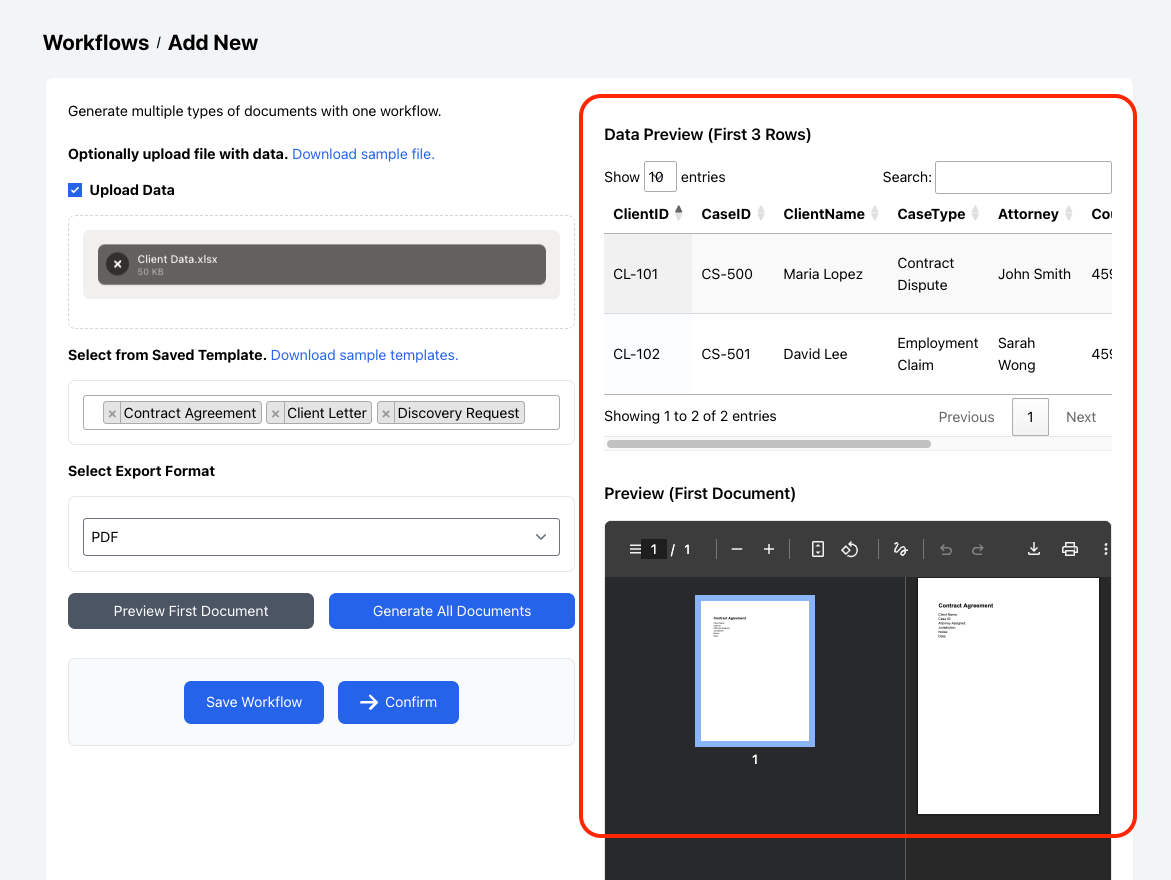
Output Example for Client CL-101 (Maria Lopez):
- Contract_Agreement_CL101.pdf
- Client_Letter_CL101.pdf
- Discovery_Request_CL101.pdf
ActiveMerge will create polished, consistent files for every row in your dataset in just minutes.
Step 8: Automate Delivery & Storage
Purpose: Ensure generated reports are delivered and archived automatically.
- Cloud Storage: Save reports in Google Drive, Dropbox, or OneDrive, organized by Batch ID or Inspection Date.
- Email Delivery: Send completed reports to supervisors, compliance officers, or plant managers automatically.
- Internal Notifications: Trigger alerts in Slack or Microsoft Teams when new reports are ready for review.


Final Thoughts
Law firms need to balance speed with accuracy. Manually building case files and contracts wastes time, risks errors, and frustrates clients.
With ActiveMerge Workflows, your firm can:
- Generate contracts, letters, and discovery requests in seconds.
- Ensure compliance and consistent formatting across all documents.
- Deliver files securely to clients, courts, or case systems automatically.
This frees attorneys to focus on strategy and advocacy—while automation handles the paperwork.
If you need help we offer a full setup services to help you start with ActiveMerge right away.
Real-World Use Cases
- Client Onboarding: Automatically generate intake forms, engagement letters, and contracts in one step.
- Court Preparation: Produce all filings, discovery requests, and supporting letters at once.
- Compliance: Generate standardized compliance and regulatory filings for audits.
- Firm Administration: Automate HR, partnership, or employment agreements internally.
FAQs
- Can I generate different documents for different case types?
Yes. Create workflows tailored to each case type (litigation, contracts, compliance) with the right templates bundled.
- What formats are supported?
PDF (default for court filings) and Word (.docx) for editable drafts.
- Is client data secure in ActiveMerge?
Absolutely. Files and data are encrypted in transit and at rest. Only authorized users can access generated files.
- Can I integrate ActiveMerge with my case management system?
Yes. Through Zapier, API, or direct uploads, you can feed case data directly into workflows.

